

Introduction
Advanced Product Quality Planning (APQP) is a structured method for defining and establishing the steps necessary to ensure that a product satisfies customer requirements and meets performance and quality objectives.
As highlighted in the APQP Reference Manual APQP_3rd Edition, the goal of product quality planning is to:
- Facilitate communication between all involved functions
- Ensure all required steps are completed on time
- Deliver quality products at the lowest cost
- Promote early identification of required changes
- Improve first-time quality in new products
APQP is not just documentation — it is a disciplined launch management framework designed to mitigate risk before production.
What is APQP?
APQP is a structured planning methodology used primarily in automotive and high-precision industries to:
✔ Translate Voice of the Customer into technical requirements
✔ Plan product and process development
✔ Validate manufacturing readiness
✔ Reduce launch risks
✔ Improve customer satisfaction
APQP integrates quality tools into a systematic planning cycle from concept to production.
Purpose of APQP
According to the manual APQP_3rd Edition, APQP provides:
- A common language across organizations
- A comprehensive process for communication
- Alignment with IATF 16949 requirements
- A framework for managing risk during product development
The methodology supports both internal and external stakeholders in structured quality planning.
The APQP Product Quality Planning Cycle
The APQP model follows a continuous improvement cycle illustrated in the manual (Product Quality Planning Cycle diagram, page viii) APQP_3rd Edition.
It integrates:
PLAN → DO → CHECK → ACT
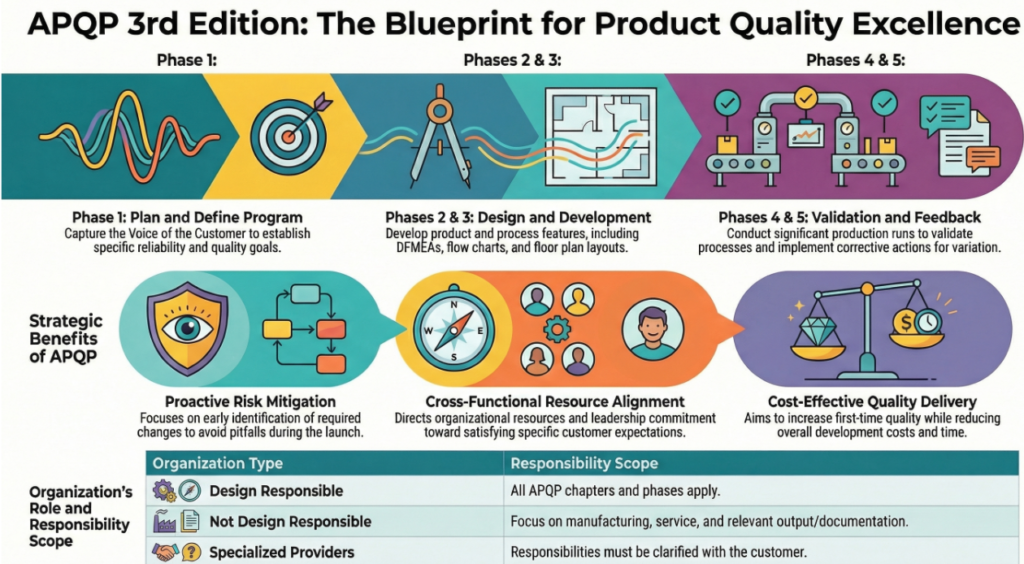
The 5 major phases include:
- Plan and Define Program
- Product Design and Development
- Process Design and Development
- Product and Process Validation
- Feedback, Assessment and Corrective Action
Each phase builds upon the outputs of the previous phase.
Phase 1: Plan and Define Program
This phase establishes the foundation for successful product realization.
Key Inputs (as identified in Chapter 1) APQP_3rd Edition
- Voice of the Customer
- Market research
- Historical warranty and quality data
- Business plan and marketing strategy
- Product/process benchmark data
- Reliability studies
- Customer quality and reliability targets
Voice of the Customer (VOC)
VOC includes:
- Customer complaints
- Surveys and interviews
- Market data
- Warranty data
- Competitive analysis
- Lessons learned
The objective is to convert customer expectations into measurable product characteristics.
Outputs of Phase 1
- Design goals
- Reliability and quality goals
- Preliminary bill of material
- Preliminary process flow chart
- Identification of special characteristics
- Product assurance plan
- Capacity planning
- Risk assessment and mitigation plan
This phase defines project direction and risk control strategy.
Phase 2: Product Design and Development
In this phase, product design is finalized and validated.
Key activities include:
- Design FMEA (DFMEA)
- Design for Manufacturability & Assembly
- Design Verification Plan & Report
- Prototype build control plan
- Engineering drawings and specifications
- Material specifications
- Special product characteristics identification
Objective: Ensure the design meets performance and reliability requirements before production tooling begins.
Phase 3: Process Design and Development
This phase ensures the manufacturing process can produce the product consistently.
Key deliverables:
- Process Flow Diagram
- Process FMEA (PFMEA)
- Control Plan (Pre-launch & Production)
- Work Instructions
- Measurement System Analysis (MSA) planning
- Packaging standards
- Production trial run planning
Objective: Translate product requirements into controlled production processes.
Phase 4: Product and Process Validation
This phase validates that production is capable under real manufacturing conditions.
Activities include:
- Significant production run
- Measurement system validation
- Preliminary process capability studies
- Production Part Approval Process (PPAP) submission
- Packaging validation
- Production control plan confirmation
Objective: Confirm readiness for mass production.
Phase 5: Feedback, Assessment & Corrective Action
After launch, continuous improvement begins.
Key focus areas:
- Customer satisfaction monitoring
- Field failure analysis
- Internal rejection trends
- Lessons learned documentation
- Corrective and preventive actions
- Process refinement
APQP is a continuous cycle — each project improves the next.
Getting Started: Practical Implementation Steps
From the “Getting Started” section APQP_3rd Edition:
Step 1: Organize the Team
- Cross-functional team required
- Include design, manufacturing, quality, purchasing, logistics, service
- Leadership involvement mandatory
Step 2: Define Scope
- Clarify customer expectations
- Identify deliverables
- Establish timeline and milestones
- Assign responsibilities
Step 3: Team-to-Team Communication
- Maintain structured communication between supplier and customer
- Conduct regular review meetings
Step 4: Training
- Ensure team understands core tools (FMEA, MSA, SPC, Control Plan)
- Build competency before execution
Step 5: Supplier Risk Management
- Identify high-risk suppliers
- Conduct risk mitigation planning
- Monitor supplier APQP activities
APQP Timing & Milestones
The Product Quality Planning Timing Chart (visible in the manual) APQP_3rd Edition demonstrates:
- Parallel execution of product and process development
- Defined gates between phases
- Overlapping planning to reduce launch time
Strong timing discipline is essential for on-time program launch.
Common APQP Implementation Failures
Organizations struggle when they:
- Treat APQP as documentation exercise
- Skip early risk assessment
- Fail to involve cross-functional teams
- Delay PFMEA until late stage
- Ignore supplier integration
- Conduct poor production validation
APQP requires leadership commitment and structured discipline.
Business Benefits of Effective APQP
Organizations implementing APQP properly experience:
✔ Reduced launch defects
✔ Faster time to market
✔ Improved cross-functional coordination
✔ Reduced warranty claims
✔ Improved customer trust
✔ Stronger supplier control
APQP is a preventive business strategy — not just a quality requirement.
How Gemba The Workplace Supports APQP Implementation
At Gemba The Workplace, we provide:
- APQP deployment workshops
- Cross-functional team facilitation
- PFMEA moderation
- Control Plan development
- Risk assessment and mitigation planning
- IATF 16949 alignment
- PPAP readiness support
Our approach is implementation-driven, practical, and audit-ready.
📞 +91 77958 24198
🌐 gembatheworkplace.com
📧 support@gembatheworkplace.com