
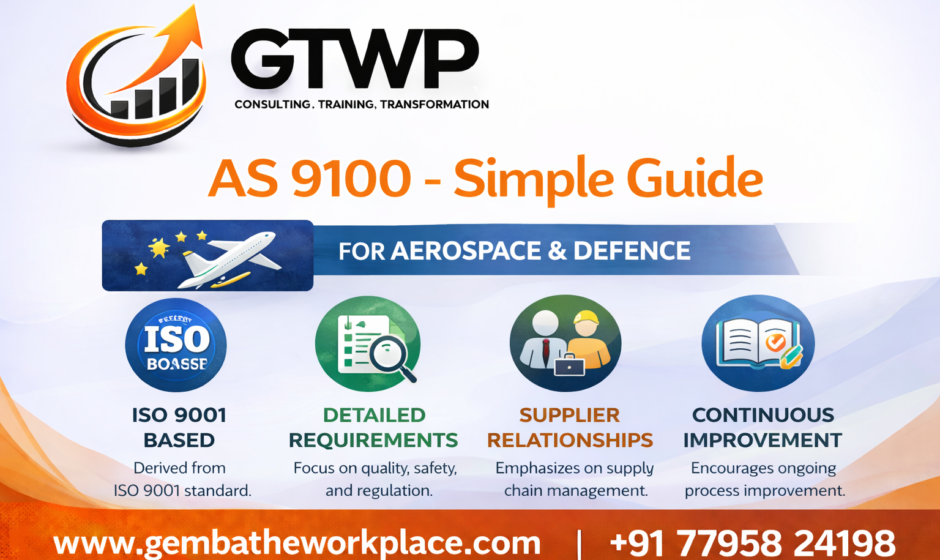


AS9100D is the globally recognized Quality Management System (QMS) standard for the aerospace and defense industry. It is built on ISO 9001:2015 but includes additional requirements to ensure the highest levels of safety, reliability, and regulatory compliance.
What Is AS9100D?
AS9100D is published by the International Aerospace Quality Group (IAQG). It applies to organizations involved in the design, development, production, assembly, and servicing of aerospace products.
Why AS9100D Matters
The aerospace industry demands zero-defect performance and strict process control. AS9100D ensures:
– Product safety
– Configuration management
– Risk-based thinking
– Supplier control
– Human factors consideration
– Regulatory compliance
Key Requirements of AS9100D
1. Product Safety
Organizations must identify safety-critical parts, processes, and controls.
2. Human Factors
Processes must consider fatigue, stress, communication, and human error.
3. Risk Management
Risks must be identified, analyzed, and controlled throughout the product lifecycle.
4. Configuration Management
Organizations must maintain strict control over product versions, changes, and documentation.
5. Counterfeit Parts Prevention
Companies must prevent, detect, and control counterfeit components.
6. Supplier Management
Suppliers must be evaluated, monitored, and developed to meet aerospace requirements.
7. Nonconformity and Corrective Action
Root cause analysis must be strong, and corrective actions must be verified for effectiveness.
Common Audit Findings in AS9100D
– Weak configuration management
– Poor risk documentation
– Incomplete product safety controls
– Ineffective corrective actions
– Missing supplier performance monitoring
AS9100D Implementation Guide (Clause 1–10) – GTWP Blog Edition
A practical, aerospace‑focused, implementation‑ready guide for manufacturing, MRO, design, and supply‑chain organizations.
1. Scope – What You Must Demonstrate
AS9100D states that the standard applies when an organization “needs to demonstrate its ability to consistently provide products and services that meet customer and applicable statutory and regulatory requirements” and aims to enhance customer satisfaction.
How to Implement
-
Define your QMS boundaries: sites, functions, product lines, outsourced processes.
-
Include design, manufacturing, MRO, special processes, software, or distribution as applicable.
-
Document statutory & regulatory applicability (DGCA, FAA, EASA, ITAR, REACH, etc.).
-
Ensure customer requirements override AS9100D when conflicts occur.
Aerospace Emphasis
-
Safety, airworthiness, traceability, and configuration control are mandatory.
-
If you handle software, integrate AS9115 guidance.
-
If you are a distributor, align with AS9120 expectations.
2. Normative References – What You Must Use
AS9100D mandates ISO 9001:2015 and ISO 9000:2015 as foundational references.
How to Implement
-
Train teams on ISO 9001:2015 structure (Annex SL).
-
Use ISO 9000 for definitions—critical for audit consistency.
-
Map AS9100D clauses to ISO 9001 to avoid duplicate documentation.
Aerospace Emphasis
-
Ensure your QMS vocabulary matches IAQG definitions (e.g., counterfeit parts, key characteristics).
3. Terms & Definitions – Aerospace‑Specific Controls
AS9100D adds aerospace‑critical definitions such as counterfeit parts, critical items, key characteristics, and product safety.
Example: “An unauthorized copy… misrepresented as a specified genuine part” defines a counterfeit part.
How to Implement
-
Create a Counterfeit Parts Prevention Procedure.
-
Identify critical items during design, FMEA, and process planning.
-
Mark key characteristics on drawings, routers, and inspection plans.
-
Integrate product safety into design reviews, FAI, and risk assessments.
Aerospace Emphasis
-
Use AS5553/AS6174 for counterfeit control.
-
Apply key characteristic controls using SPC, MSA, and PFMEA.
4. Context of the Organization – Build the Foundation
AS9100D requires determining “external and internal issues relevant to its purpose and strategic direction”.
How to Implement
-
Conduct a Context Analysis Workshop:
-
External: regulatory changes, supply chain risks, geopolitical issues.
-
Internal: capability, capacity, technology, workforce skills.
-
-
Identify interested parties: OEMs, authorities, suppliers, MRO partners.
-
Define QMS scope and process interactions.
Aerospace Emphasis
-
Include airworthiness authorities as interested parties.
-
Map special processes (NDT, heat treatment, welding) clearly in process maps.
5. Leadership – Demonstrate Commitment
Leadership must show commitment to customer focus and QMS effectiveness.
AS9100D highlights “leadership and commitment” and “customer focus”.
How to Implement
-
Publish a Quality Policy aligned with safety and airworthiness.
-
Define roles & authorities for configuration, product safety, and risk.
-
Conduct Management Reviews with aerospace‑specific inputs:
-
escapes, audit findings, supplier performance, FOD events, safety issues.
-
Aerospace Emphasis
-
Appoint a Product Safety Manager.
-
Leadership must review operational risk, not just quality metrics.
6. Planning – Risk, Objectives, and Change
AS9100D requires planning actions to address risks and opportunities.
It emphasizes “operational risk management” and “special requirements”.
How to Implement
-
Create a Risk Register covering:
-
design risks
-
manufacturing risks
-
supplier risks
-
counterfeit risks
-
product safety risks
-
-
Set measurable quality objectives (escape rate, OTD, FAI success).
-
Implement controlled change management for design, process, and configuration.
Aerospace Emphasis
-
Use APQP/PPAP for new product introduction.
-
Identify special requirements early during contract review.
7. Support – Build Capability
AS9100D expands ISO 9001 with aerospace‑specific requirements for competence, document control, and monitoring resources.
How to Implement
-
Maintain competency matrices for NDT, welding, special processes.
-
Control documented information with revision control and configuration discipline.
-
Calibrate equipment traceable to national/international standards.
-
Maintain organizational knowledge (lessons learned, design guidelines).
Aerospace Emphasis
-
Implement FOD prevention programs.
-
Maintain special process certifications (NADCAP where applicable).
8. Operation – The Heart of AS9100D
This is the most aerospace‑intensive clause.
It includes operational risk management, configuration management, product safety, counterfeit parts prevention, and more.
8.1 Operational Planning
-
Use process flow diagrams, PFMEA, control plans.
-
Identify critical items and key characteristics.
8.1.1 Operational Risk Management
-
Assess risks for:
-
new technology
-
complex assemblies
-
special processes
-
supplier instability
-
-
Implement mitigation plans.
8.1.2 Configuration Management
-
Maintain BOM accuracy, revision control, change logs.
-
Ensure production uses latest released configuration.
8.1.3 Product Safety
-
Integrate safety into:
-
design reviews
-
FAI
-
process planning
-
maintenance instructions
-
8.1.4 Counterfeit Parts Prevention
-
Validate suppliers.
-
Inspect for authenticity.
-
Maintain traceability to OEM/OCM.
8.2 Requirements for Products & Services
-
Conduct contract review for special requirements.
-
Manage customer communication (changes, deviations, concessions).
8.3 Design & Development
-
Plan design stages, reviews, verification, validation.
-
Identify critical items and key characteristics in outputs.
8.4 Control of External Providers
-
Approve suppliers based on capability.
-
Flow down requirements (FOD, safety, key characteristics).
-
Monitor supplier performance.
8.5 Production & Service Provision
-
Use controlled work instructions.
-
Maintain traceability.
-
Protect customer property.
-
Manage post‑delivery activities (warranty, service bulletins).
8.6 Release of Products
-
Use FAI (AS9102).
-
Ensure independent inspection for critical items.
8.7 Control of Nonconforming Outputs
-
Segregate, disposition, and report escapes.
-
Use MRB with customer approval where required.
9. Performance Evaluation – Measure What Matters
AS9100D requires monitoring, measurement, analysis, and evaluation.
Includes “customer satisfaction”, “internal audit”, and “management review”.
How to Implement
-
Track:
-
OTD
-
escape rate
-
audit findings
-
supplier performance
-
FOD incidents
-
safety events
-
-
Conduct internal audits covering all AS9100D clauses.
-
Perform management reviews with aerospace‑specific data.
Aerospace Emphasis
-
Include airworthiness, safety, configuration issues, and regulatory compliance in reviews.
10. Improvement – Prevent, Correct, Improve
AS9100D requires “nonconformity and corrective action” and “continual improvement”.
How to Implement
-
Use structured RCA tools:
-
8D
-
Fishbone
-
5 Why
-
Fault Tree
-
-
Track corrective actions to closure.
-
Implement lessons learned across programs.
-
Drive continual improvement using:
-
SPC
-
Lean
-
Kaizen
-
APQP feedback loops
-
Aerospace Emphasis
-
Focus on escape prevention, not just correction.
-
Share lessons learned across platforms, programs, and suppliers.