
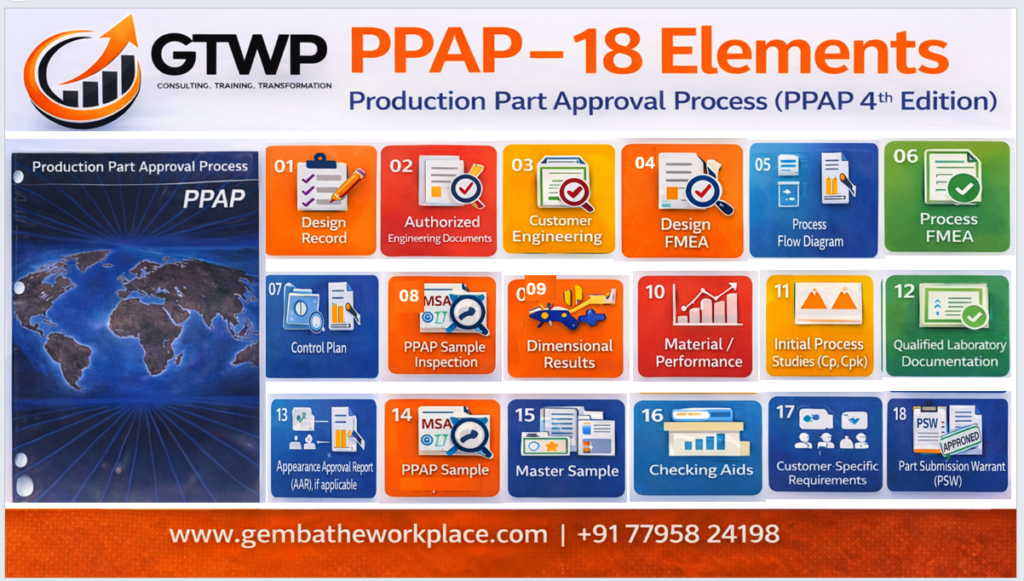
PPAP – 18 Elements Explained with Practical Examples
Production Part Approval Process (PPAP) is a structured method used in the automotive and manufacturing industries to ensure that suppliers understand customer requirements and that the manufacturing process consistently produces conforming products.
PPAP verifies that design records, engineering requirements, and production processes are properly documented and validated before mass production begins.
AIAG-Production-Parts-Approval-…
Below are the 18 PPAP elements from the AIAG PPAP 4th Edition explained with simple examples.
1. Design Record
What it is
Official engineering drawing or CAD model defining product specifications.
Contains dimensions, tolerances, material specifications, and notes.
Example
Automotive bracket drawing showing:
Hole diameter = 10 ±0.05 mm
Material = Mild Steel IS2062
Surface finish requirement.
2. Authorized Engineering Change Documents
What it is
Documents that record design changes approved by the customer or engineering team.
Example
Engineering Change Notice (ECN) changing:
Material from Aluminum to Stainless Steel
Hole diameter from 8 mm to 10 mm.
3. Customer Engineering Approval
What it is
Approval from the customer confirming the design meets functional requirements.
Example
OEM approval for a dashboard plastic component after testing fitment and durability.
4. Design FMEA (DFMEA)
(Applicable if supplier is responsible for product design)
What it is
Risk analysis of potential failures in the product design.
Example
| Failure Mode | Effect | Control |
|---|---|---|
| Bracket bending | Assembly failure | Increase thickness |
5. Process Flow Diagram
What it is
Visual representation of the entire manufacturing process.
Example
Raw Material → Cutting → CNC Machining → Deburring → Inspection → Packing
6. Process FMEA (PFMEA)
What it is
Risk analysis of failures during the manufacturing process.
Example
| Process Step | Failure | Control |
|---|---|---|
| Drilling | Hole oversized | SPC monitoring |
7. Control Plan
What it is
Document defining how process and product quality will be controlled.
Example
| Process | Characteristic | Method |
|---|---|---|
| CNC Drilling | Hole diameter | Vernier inspection every hour |
8. Measurement System Analysis (MSA)
What it is
Study verifying measurement equipment accuracy and repeatability.
Example
Gauge R&R study for digital caliper measuring hole diameter.
Result Example
Gauge R&R = 8% (Acceptable)
9. Dimensional Results
What it is
Actual measurement results compared with drawing specifications.
Example
| Characteristic | Spec | Actual |
|---|---|---|
| Hole Diameter | 10 ±0.05 | 10.01 mm |
10. Records of Material / Performance Test Results
What it is
Evidence that the material and product meet specified requirements.
Example
Tensile strength test report for steel component.
Salt spray test report for corrosion resistance.
11. Initial Process Studies (Cp / Cpk)
What it is
Statistical capability study proving process stability.
Example
| Characteristic | Cpk |
|---|---|
| Hole diameter | 1.75 |
Interpretation
Cpk > 1.67 → Process capable.
12. Qualified Laboratory Documentation
What it is
Evidence that testing laboratories are accredited.
Example
NABL / ISO 17025 certificate of laboratory performing material tests.
13. Appearance Approval Report (AAR)
(Applicable when appearance matters)
What it is
Approval for visual characteristics such as color, texture, or finish.
Example
Paint color approval for vehicle bumper.
14. Sample Production Parts
What it is
Parts produced from actual production process and tooling.
Example
300 parts produced during trial run for PPAP submission.
15. Master Sample
What it is
Approved reference sample kept for comparison.
Example
One approved component stored at supplier site and one at customer site.
16. Checking Aids
What it is
Fixtures, gauges, templates used for inspection.
Example
Go/No-Go gauge for checking slot width.
17. Customer-Specific Requirements
What it is
Additional requirements defined by OEM customers.
Example
Ford requiring capability index Cpk ≥ 1.67
Toyota requiring special packaging.
18. Part Submission Warrant (PSW)
What it is
Final declaration confirming all PPAP requirements are completed.
Example
Supplier signs PSW confirming:
All PPAP elements completed
Product meets customer requirements.
This document formally approves the part for mass production.
Level 1 – Part Submission Warrant Only
What is submitted
Only the PSW (Part Submission Warrant).
When it is used
For low-risk parts.
For simple components.
When customer already has confidence in the supplier process.
Example
Standard fasteners supplied to an OEM with an already proven process.
Level 2 – PSW + Limited Supporting Data
What is submitted
Part Submission Warrant (PSW)
Limited supporting documents such as:
Dimensional results
Material test results
Process capability summary
When it is used
Moderate risk components.
When customer wants basic evidence but not the full PPAP package.
Example
Sheet metal brackets supplied to a vehicle manufacturer.
Level 3 – PSW + Complete Supporting Data (Most Common)
What is submitted
PSW
Complete PPAP documentation package, including:
Design record
PFMEA
Process Flow Diagram
Control Plan
MSA studies
Capability studies
Dimensional results
Test results
Sample parts
When it is used
Standard requirement for most automotive parts.
Example
Automotive engine mounting bracket supplied to OEM.
Level 4 – PSW + Other Requirements Defined by Customer
What is submitted
PSW
Documents requested by customer
Additional validation or testing as required.
When it is used
High-risk components.
Safety-critical parts.
Example
Brake system component requiring additional validation and testing.
Level 5 – PSW + Complete Data Reviewed at Supplier Site
What is submitted
PSW
Full PPAP documentation.
Difference
Instead of submitting documents, customer reviews them at the supplier manufacturing location.
When it is used
Very critical components.
New suppliers or complex manufacturing processes.
Example
Transmission assembly components requiring on-site verification.
Typical PPAP Level Comparison
| PPAP Level | Submission Requirement | Typical Use |
|---|---|---|
| Level 1 | PSW only | Low risk parts |
| Level 2 | PSW + limited data | Moderate risk |
| Level 3 | PSW + full documentation | Standard automotive requirement |
| Level 4 | PSW + customer defined | Special cases |
| Level 5 | PSW + full review at supplier site | Critical parts |
Key Points to Remember
Level 3 is the default PPAP level used in most automotive projects.
AIAG-Production-Parts-Approval-…
The customer decides the required submission level.
Higher levels require more detailed validation and documentation.
All PPAP records must be retained even if not submitted to the customer.
How Gemba The Workplace Supports PPAP Submissions
At Gemba The Workplace, we help manufacturing organizations successfully complete PPAP submissions through:
PPAP documentation preparation
PFMEA, Control Plan and Process Flow development
MSA and SPC implementation
Process capability studies
IATF 16949 compliance support
Automotive core tools training
🌐 Website: www.gembatheworkplace.com
📞 Contact: +91 77958 24198
We help organizations achieve successful PPAP approvals and strengthen supplier quality performance.