

In every manufacturing or industrial environment, equipment reliability is the backbone of productivity. When machines fail, everything stops—output, delivery commitments, customer satisfaction, and profitability.
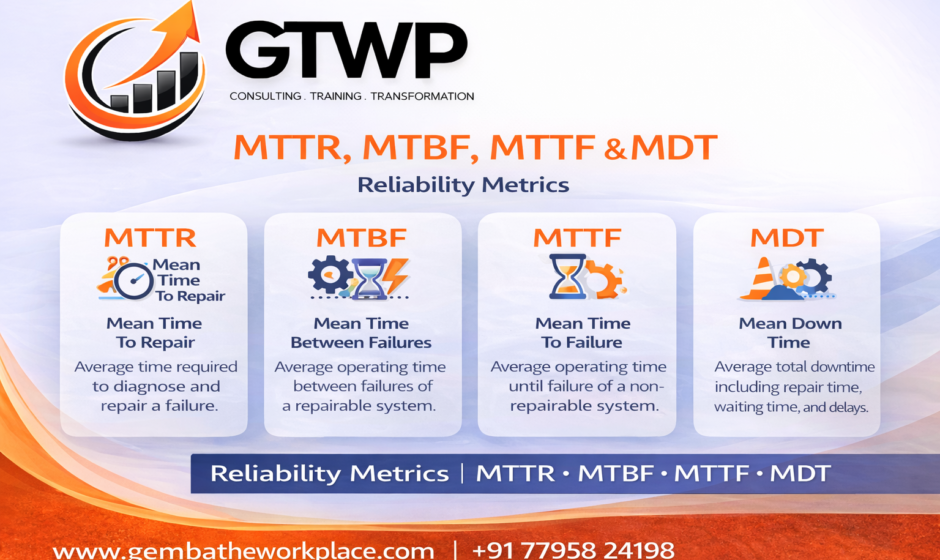
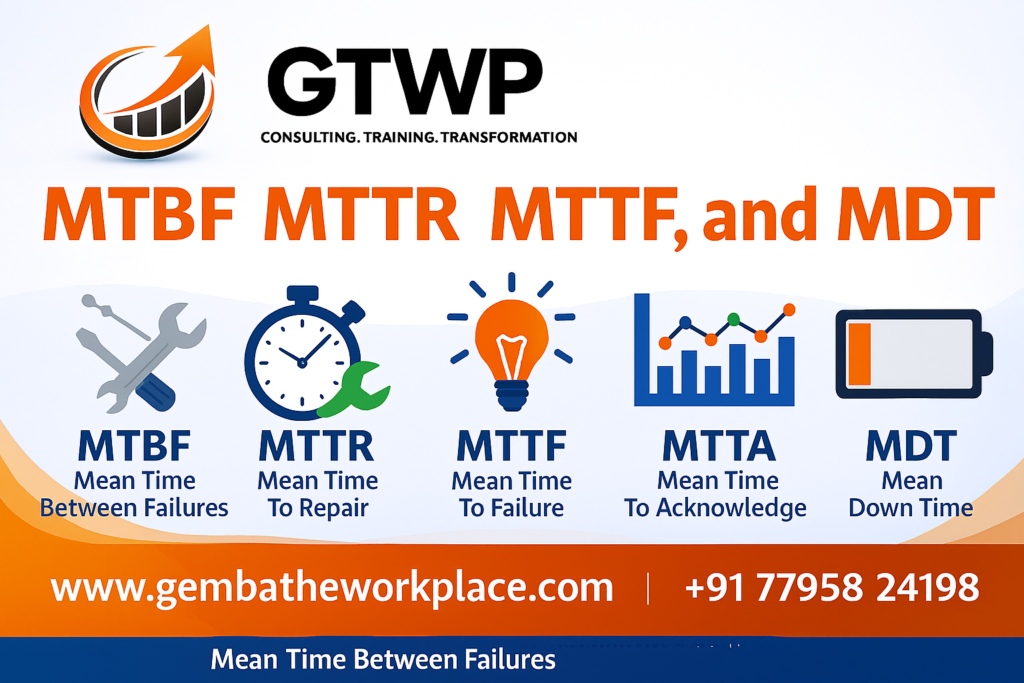
This is why world‑class organizations rely on a set of powerful reliability metrics: MTBF, MTTR, MTTF, MTTA, and MDT.
These metrics don’t just measure performance—they reveal hidden losses, expose systemic issues, and guide leaders toward smarter maintenance strategies.
This article breaks down each metric in a simple, practical way and shows how you can use them to build a more reliable, efficient, and profitable workplace.
⭐ Why Failure Metrics Matter
Before diving into the metrics, it’s important to understand the foundation:
- Failure — When a system or component cannot perform its intended function.
- Reliability — The probability that equipment performs without failure for a specified time.
- Availability — The percentage of time equipment is operational.
- Uptime — Productive time.
- Downtime — Lost time due to failures or maintenance.
These metrics help you answer critical questions:
- How often does equipment fail?
- How long does it take to repair?
- How reliable are components?
- How quickly does the team respond?
- How much time is lost overall?
1. MTBF – Mean Time Between Failures
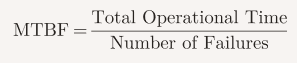
MTBF is the average time a repairable asset operates before failing again.
It is one of the most important indicators of equipment reliability.
Formula
Why MTBF Matters
- Predicts how often failures occur
- Helps plan preventive maintenance
- Improves reliability and availability
- Supports spare parts planning
- Helps justify repair vs. replace decisions
Example from the document
Three machines fail at 120, 140, and 150 hours.

This means the machine fails roughly every 136.67 hours.
How to Improve MTBF
- Better design and engineering
- Strong preventive maintenance
- Condition-based monitoring
- Root cause analysis
- Quality spare parts
- Kaizen, 5S, Poka‑Yoke initiatives
2. MTTR – Mean Time To Repair
MTTR measures how long it takes to repair equipment and restore it to normal operation.
Formula

What MTTR Includes
- Alerting technicians
- Diagnosis
- Repair work
- Cooling time
- Reassembly, alignment, calibration
- Testing and restart
Why MTTR Matters
- Directly impacts productivity
- High MTTR = high downtime cost
- Helps identify bottlenecks in maintenance
- Supports decisions on spare parts stocking
- Indicates team skill and process efficiency
How to Reduce MTTR
- Standardized repair procedures
- Better troubleshooting guides
- 5S for tools and spares
- CMMS implementation
- Training and skill development
- Quick escalation processes
3. MDT – Mean Down Time
MDT measures the total time equipment is unavailable, including both scheduled and unscheduled downtime.
Formula

What MDT Includes
- Failure time
- Diagnosis
- Waiting for spares
- Lockout/Tagout
- Repair
- Testing and restart
Why MDT Is Important
- Shows true impact of downtime
- Helps evaluate maintainability
- Highlights inefficiencies in repair processes
- Supports spare parts strategy
- Tracks downtime reduction initiatives
How to Reduce MDT
- Strong maintenance strategy (FMECA, RCM, PM)
- Planned downtime during low-demand periods
- CMMS for documentation and tracking
- Root cause analysis for recurring failures
4. MTTA – Mean Time To Acknowledge
MTTA measures how quickly the team responds to an alert or incident.
Formula

Why MTTA Matters
- Indicates responsiveness
- Helps detect alert fatigue
- Improves service dependability
- Reduces downtime by faster reaction
How to Reduce MTTA
- Automation tools
- Real-time monitoring
- Clear escalation paths
- Root cause elimination
- Better alert filtering
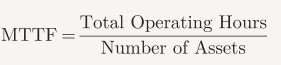
5. MTTF – Mean Time To Failure
MTTF applies to non‑repairable assets—items that are replaced, not repaired.
Formula
Examples of MTTF Assets
- Light bulbs
- Fan belts
- Conveyor rollers
- Transistors
- Forklift wheels
Why MTTF Matters
- Helps plan replacement schedules
- Supports just‑in‑time inventory
- Guides purchasing decisions
- Improves asset lifecycle planning
Comparison: MTBF vs. MTTR vs. MTTF
How These Metrics Work Together
When used together, these metrics give a complete picture of equipment health:
- MTBF tells you how often failures happen
- MTTR tells you how fast you recover
- MDT tells you how much time you lose
- MTTA tells you how fast you respond
- MTTF tells you how long components last
This combination helps you build a predictive, proactive, and data-driven maintenance system.
Conclusion
Reliability metrics are not just numbers—they are powerful tools for transforming your workplace.
By mastering MTBF, MTTR, MTTF, MTTA, and MDT, you can:
- Reduce downtime
- Improve productivity
- Strengthen preventive maintenance
- Optimize spare parts
- Increase equipment lifespan
- Boost customer satisfaction
- Build a culture of continuous improvement
These metrics are the foundation of world‑class maintenance and operational excellence.