
Introduction
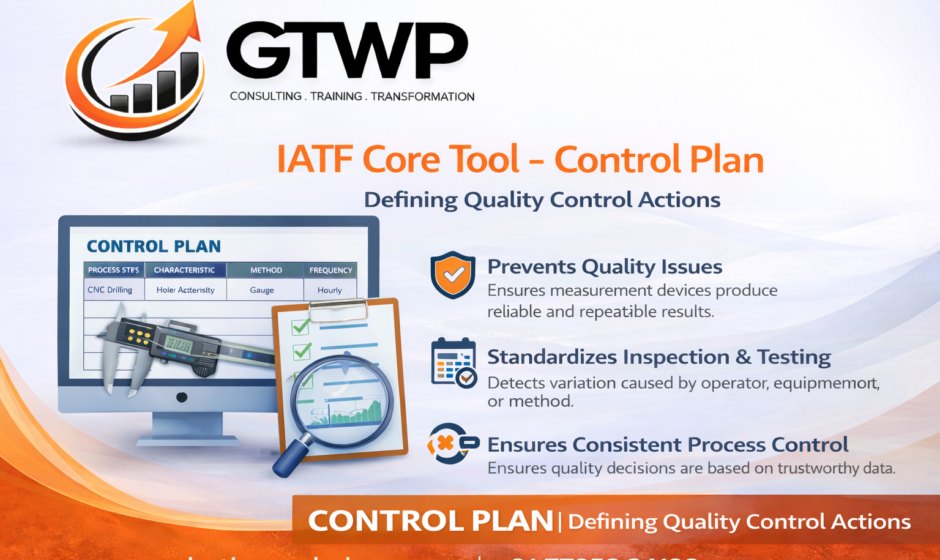
In manufacturing, identifying risks is not enough. Risks must be controlled, monitored, and reacted to in real time. This is where the Control Plan plays a critical role.
As defined in the AIAG Control Plan Reference Manual Control Plan_1st Edition, a Control Plan is a structured written description of the systems and methods used to minimize process and product variation.
It translates risk analysis (PFMEA) into daily shop-floor execution.
What is a Control Plan?
A Control Plan documents:
- What characteristics are controlled
- How they are controlled
- How often they are checked
- Who is responsible
- What action is taken when something goes wrong
In simple terms:
PFMEA identifies risk — Control Plan controls the risk.
Control Plans are mandatory in:
- APQP
- PPAP submissions
- IATF 16949 certified organizations
- Automotive and regulated manufacturing sectors
Purpose of a Control Plan
According to the manual Control Plan_1st Edition, Control Plans are intended to:
✔ Create a common language between customer and supplier
✔ Reduce process and product variation
✔ Support consistent manufacturing execution
✔ Ensure special characteristics are controlled
✔ Provide clear reaction plans for nonconformities
✔ Support continual improvement
A Control Plan is not an inspection sheet — it is a process control strategy.
Control Plan in the Product Life Cycle
The Control Plan is used throughout the entire product life cycle Control Plan_1st Edition:
- Early development → documents initial process controls
- Pre-launch → validates readiness and containment
- Mass production → defines standard control methods
- Post-launch → evolves with lessons learned
It is a living document, continuously updated.
Types of Control Plans
The manual defines three phases of Control Plans Control Plan_1st Edition:
1. Prototype Control Plan
- Used during product design validation
- Focuses on dimensional, material, and functional tests
- Supports engineering builds and trials
2. Pre-Launch Control Plan
- Used before full production approval
- Includes additional inspections and containment
- Often called Safe Launch Control Plan
3. Production Control Plan
- Used during mass production
- Based on proven, capable processes
- Focuses on long-term process stability
Each phase builds on the previous one.
Relationship with APQP, PFMEA, and PPAP
The Control Plan is tightly linked to other core tools:
| Tool | Relationship |
|---|---|
| APQP | Control Plan is an APQP output |
| PFMEA | Control Plan controls PFMEA risks |
| Process Flow | Control Plan follows process steps |
| PPAP | Control Plan is a mandatory PPAP element |
| IATF 16949 | Control Plan supports clause 8.5 |
Weak linkage between PFMEA and Control Plan is a common audit nonconformity.
Control Plan Methodology
The Control Plan describes actions required at each process step, including Control Plan_1st Edition:
- Receiving
- In-process operations
- Special processes
- Final inspection
- Packaging and shipping
It does not replace work instructions, but complements them by defining what to control and how.
Control Plan Format – What Must Be Included
The manual states that format is flexible, but minimum content is mandatory Control Plan_1st Edition.
A Control Plan must include:
- Process step number
- Process description
- Product / process characteristic
- Special characteristic identification
- Specification / tolerance
- Measurement or control method
- Sample size and frequency
- Control method (SPC, mistake-proofing, inspection)
- Reaction plan
- Responsible function
Clarity and usability are more important than layout.
Special Characteristics in Control Plans
Special characteristics are those that impact Control Plan_1st Edition:
- Safety
- Regulatory compliance
- Fit, form, or function
- Critical performance
Requirements:
- All special characteristics must appear in the Control Plan
- PFMEA items with Severity 9–10 must flow into the Control Plan
- Customer-specific symbols must be respected
If not defined by the customer, organizations must define and apply their own consistently.
Pass-Through Characteristics (PTC)
Pass-Through Characteristics are features:
- Not created by the supplier
- But capable of impacting final product performance
Examples:
- Supplier-controlled dimensions
- Incoming material properties
The manual requires Control Plan_1st Edition:
- Identification of PTCs
- Validation of supplier controls
- Inclusion in the Control Plan
- Pre-launch customer review for PTCs
Error-Proofing in Control Plans
Error-proofing (Poka-Yoke) must be:
- Listed in the Control Plan
- Verified for effectiveness
- Periodically validated
Requirements include Control Plan_1st Edition:
- Verification method and frequency
- Use of master samples (e.g., red rabbits)
- Protection against misuse of defect samples
Error-proofing without verification is ineffective.
a.Families of Control Plans
A Family Control Plan may be used when:
- Parts are similar in design and process
- Same equipment and tooling are used
- Same control methods apply
Conditions Control Plan_1st Edition:
- All part numbers must be listed
- PFMEA must justify similarity
- Controls must be identical
b.Rework and Repair in Control Plans
If rework or repair is allowed, the Control Plan must Control Plan_1st Edition:
- Clearly define rework steps
- Identify start and end points
- Require customer approval where applicable
- Ensure traceability of reworked parts
- Re-enter parts into main control flow
Uncontrolled rework is a major quality risk.
c.Reaction Plans – The Heart of Control Plans
Reaction plans define what happens when control is lost.
Requirements include Control Plan_1st Edition:
- Immediate containment actions
- Identification and segregation of suspect product
- Responsibility and authority
- Documentation and escalation
- Reference to problem-solving method
A Control Plan without a reaction plan is incomplete.
100% Visual Inspection – Caution
The manual warns that reliance on 100% inspection carries risk Control Plan_1st Edition:
- Human error
- Misinterpretation
- Fatigue
If used, it must include:
- Periodic verification
- Defined responsibility
- Customer-approved standards where applicable
Control Plan Implementation – Step by Step
Step 1: Align with Process Flow
Each process step must appear in the Control Plan.
Step 2: Link PFMEA to Control Plan
High-risk failure modes must have controls.
Step 3: Identify Characteristics
Product and process characteristics clearly defined.
Step 4: Define Control Methods
Prefer prevention over detection.
Step 5: Define Reaction Plans
Clear, fast, and practical.
Step 6: Train Shop-Floor Teams
Operators must understand and follow the plan.
Step 7: Maintain and Update
Update for changes, complaints, and lessons learned.
16️⃣ Common Control Plan Mistakes
Organizations fail when they:
- Copy Control Plans without process review
- Do not update after changes
- Have weak reaction plans
- Do not link PFMEA
- Use inspection instead of prevention
- Treat Control Plan as customer document only
Business Benefits of Effective Control Plans
✔ Reduced variation
✔ Fewer defects and complaints
✔ Stable production processes
✔ Strong audit performance
✔ Improved customer confidence
✔ Faster response to issues
Control Plans convert risk analysis into daily discipline.
How Gemba The Workplace Supports Control Plan Implementation
At Gemba The Workplace, we support organizations with:
- Control Plan development & review
- PFMEA–Control Plan linkage
- Safe Launch Control Plans
- Operator-friendly Control Plans
- IATF 16949 audit preparation
- Practical shop-floor implementation
📞 +91 77958 24198
🌐 gembatheworkplace.com
📧 support@gembatheworkplace.com
Final Thoughts
A Control Plan is not paperwork.
It is the bridge between engineering intent and manufacturing reality.
When implemented correctly:
- Risks are controlled in real time
- Problems are contained immediately
- Quality becomes predictable
PFMEA identifies risk.
Control Plan controls risk.